|
|
|
|
|
|
|
|
How To Buy A Hearse - By
Zachary Byron Helm
The
following is an article written for the prospective buyer. It is not intended to
be a compendium of irrefutable facts, but rather act as a reference point for
people who have no background in the hobby. The main purpose is just to educate
so that people who are looking into buying a hearse will have a better idea of
what to expect and how to go about looking for one of these cars. This guide
does have some exclusions in it, mostly for the fact that I felt the information
contained within would cover the hearses that you would be most likely to
encounter while on your search.
When I am cruising down the road, I usually get one of two questions. The number
one question being: "Hey, where can I find a hearse like that?" to which I am
usually compelled to take some time out and try to answer their question and
hopefully help them find a hearse.
The second question I am usually asked is: "Hey, got any DEAD BODIES back
there?" to which I am usually compelled to want to lunge through my window, grab
the offending individual by the ankles and then swing their body against the
cement until their bones are liquefied inside their flesh . I mean, what do they
think, I just carry around dead bodies for fun? Like I take one with me whenever
I go through the drive through at Carl's Junior? Yeah Pal, I sure do, I just
LOVE dead corpses, I just always gotta have one with me, at home, in the car,
wherever good times are had...cripes.
Also, fair warning; You will encounter morons who will yell out "Ghostbusters!"
because they think your car looks like Ecto 1. These are people who do not
realize that the car they are heckling is usually about 20 years older, a
completely different body type and usually not even the same color. It's like
saying Dolly Parton and Pamela Anderson are the same person because they share
some similarities. Sure, they're both blondes with bigger breasts than most city
building permits should allow, but one is a talented country gospel singer and
the other is a filthy bimbo.
Anyway, I digress. This is about buying yourself a hearse, not the morons that
you will encounter on a daily basis once you have bought one.
There are some things that you must know before buying a hearse. If this is to
be a car that you even use recreationally, you should bear these facts in mind:
A hearse usually gets about 10 to 15 miles per gallon on a good day. You can
expect a mechanical problem at least every 30 to 60 days or so. Some of these
problems will be simple, like needing more oil, or a blown fuse, others will be
living waking nightmares from which there will never be any rest. Your only
possible release from these problems being either the eventual sale of the
hearse to someone else, or your own death. I am not messing around with you here
people. My hearse has problems that have been 'fixed' dozens of times and keep
returning.
A lot of common hearse problems are easily noticeable by the fact that they will
cause an unpleasant, nagging noise from your engine compartment. This is usually
an excellent indicator that there is a problem present. You can take care of it
one of three ways:
1. Fix the problem yourself
2. Pay a certified mechanic to fix the problem
3. Buy a stereo that is loud enough to drown out the noise of the afore
mentioned problem. I personally have remedied a lot of mechanical woes this way,
I just make sure that the stereo is at least 80 db at all times, and I never
worry one bit.
Yes, you may be one of those people who can afford to buy a hearse for $8,000
that has no problems and has been stored indoors all it's life, but chances are
you are not, your'e like the rest of us who just want something cool and should
be willing to make some of the sacrifices that come with it. I strongly
recommend that you learn some basic auto repair skills. You might not want to,
but it will save you hundreds in repair bills and is strangely addictive. I
personally love the people who give me this line-
"Oh, I don't need to learn how to work on my hearse. My brothers uncle in laws
cousin is a certified mechanic and he'll rebuild my entire engine for a pack of
Bud Light."
Ok, not to call bullshit on you or anything, but I am going to do exactly that.
Even if you do know this magical person who will do $3500 repairs for a $5
container of beer, the fact of the matter is this - After about the 5th time in
a row you call them because you can't take care of your own vehicle, they are
probably going to tell you to eat root. Look at it this way, I personally fix my
own cars all the time, and you know what? Even though I own the car, and it
personally benefits me to fix it, I don't really want to work on it all the
time. It's my pride and joy, but after 6 repairs in a row, I don't want to look
at the damned thing, let alone work on it, so what makes you think someone else
wants to work on your POS? Unadulterated altruistic love of seeing the look of
joy on your face as they put your crappy car back together again for slave
wages? Hell no, get real. Learn to work on your own car and save time and money,
that is all there is to it. It's not all that hard, for the most part all you
usually have to do is look for the part that is spewing the liquid it is not
supposed to be spewing, pull it off, take it over to the parts store and get a
new one.
I have re-written and added things to this article over the years and one thing
that has changed is that even in the last 5 years, YOUTUBE has gotten insanely
glorious with uploaded repair videos. Damned near any repair you need to do is
covered on a how to video on there, use it to your advantage. The info to become
your own mechanic has never before been more thorough, quality and accessible
than it is now, take advantage of it!
ATTENTION!
One thing to keep an eye out for is the seller that claims the car is worth more
because it is 'rare'
If you have some seller asking your for a few extra thousand dollars for some
rusting bucket of bolts that needs paint because it is 'rare' chances are good
that you can walk that one right over to the B.F.D. file because ALL HEARSES ARE
RARE. Prior to 1977 there were so many combinations of body types, interior
styles, fabric selections and colors that it is rare you ever see two that are
exactly alike.
Some features will make the car
worth more, LT1 engines, red or black interiors, extending tables, crown roofs,
etc but be wary of anyone demanding thousands more.
Custom hearses are another red flag. I see these online all the time, they
usually have a set of flashy wheels, a big stereo and a gaudy paint job with
tons of skulls and flames. I have nothing against any of these things but they
ARE the holy trinity of hearse owners who go full retard then sell their car a
year later. It also doesn't mean a 1984 S&S is now worth $15,000. Look, these
are all upgrades you can do yourself, don't fall for the dick demanding more
money because his "One of a kind/Work of art" has a picture in front of 10
trophies, it's not worth that much.
Also, the next paragraph, read it and heed it-
There is NO 501, 502 or ANY OTHER standard Cadillac engine larger than the 500.
END OF STORY. I hear this all the time, the "Oh yeah, my car has the 502 in it"
and it never fails to make me want to hit the person with a Chilton's manual (a
double insult since not only am I assaulting them, I am doing it with a really
crappy, uninformative book that tries to pass itself off as a serious piece of
reference material). This misinformation was started by goobs who could not read
their engine tags correctly and just started making assumptions that were wildly
incorrect about their engine size. IT DOES NOT EXIST. If you can find me any
REAL documentation, like say a Cadillac owners manual that makes any reference
to this mythical beast of an engine, then I will delete this paragraph and make
a full public apology.
Another thing I hear a lot is this line-
"I want a hearse, but it needs to be one that doesn't need a lot of repairs, is
reliable, in great shape and gets good gas mileage as well. If it could be under
$1500 that would be great"
Ok, and when the Leprechaun shows up with the keys to this dream hearse of yours
as well as the pot of gold and the extra three inches added to your reproductive
organ you send him my way next, because this is a fairy tail. There is no such
car and here is why:
1. Hearses are USED cars. Unless you want to spend $75,000 on a new one you are
going to end up doing repairs.
2. Hearses are big cars, there is no such thing as good mileage on a 7,000+
pound vehicle.
If such a magic hearse existed, everyone in this club would own one.
The other thing to bear in mind is that these are commonly perceived as 'Fun'
cars, or that they are going to be a great vehicle to cruise around in and relax
in. THIS IS NOT TRUE!!! Hearses are great cars, but they are also hellish bitch
goddesses that are only truly happy when every ounce of your soul and money have
been put forward for their own well being. If you get a hearse, KNOW that it
will only be truly content once you have spent endless hours loving it, working
on it, and spending every last dime you have to your name on it! No, do not even
put a little cash aside to buy food to keep yourself nourished, because I swear
the car will know! It will sense that you have not given it all that there is to
your name, and it will develop ANOTHER major mechanical problem!
Ok, so that out of the way, you are ready to start looking for a hearse. But
what are the approximate values for different hearses, and how do you tell what
you are getting or even what you are looking at?
What type of hearse are you seeking out? Do you want the classic uniform hearse
(I.E. Landau bars, casket table, only Cadillac with big fins) or are you open to
anything?
ONE IMPORTANT WORD ON PRICES! The following section is about pricing. Now, I am
outlining common prices here and I do want to put out on caveat to these prices,
it is that if you are patient, if you are willing to look around and learn about
your hearse options and actually do some legwork you CAN still find great deals
BUT BE WARY -
Cheap Doesn't Always End Up Being Cheap!
I have bought cheap hearses that were beasts that ran like a champ for years but
generally speaking, if you have a choice between a hearse with a bad paintjob,
body rust and broken glass for $1000 and one that has perfect paint and body for
$4500, save up and get the $4500 one. It will ALWAYS be cheaper to buy into an
already nice hearse than to pay someone to do the paint and body (Unless you do
it yourself, in which case, you rock)
I mention this because I don't
want you to read the prices and get discouraged. One of the fantastic things
about this hobby is that it is accessible to people who don't have a ton of cash
or big ass credit scores which is part of it's charm. Be patient, look around
and find the right deal for you, it can happen!
As a general rule, the older the hearse, the more you can expect to pay. The
most common years when you are looking for fins on a Cadillac product are 1958
to 1964. These hearses are popular because they embody the classic look of a
funeral car in their luxury and excess. A hearse in these years can range from a
rusty but restorable coach for about $4000 on up to a restored coach for $15,000
plus.
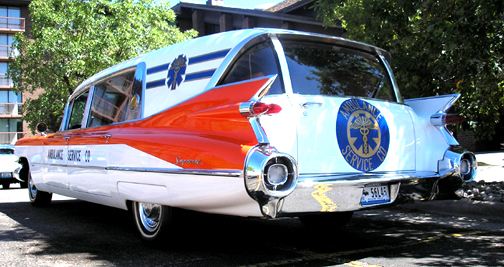
One thing I hear a lot of too is "I want a hearse, I won't accept anything
unless it's a 1959 Cadillac Superior 3-way with a red velvet interior and in
great condition. I will wait to find the right car"
If this is you, please shut up.
First off, you're probably driving a Neon right now so stop demanding that the
first hearse you get is the crown jewel of the hearse collecting hobby.
Secondly, chances are almost staggeringly high to nearly absolute that you don't
know enough about hearses to know a 59 from a 64. If you did you wouldn't be
demanding the one car that is going to be harder to find and more expensive than
anything else, you'd know better.
Let me bottom line it for you - if you have high fallutin' tastes and demands,
you're going to be an insufferable douche.
If what you know is that you want a car that carried dead people and has one of
those silver "S" looking things on the back panels, then you're probably a much
more tolerable person because you have no expectations and are just going to be
happy having nearly ANY hearse. Thank you in advance for being that person.
Also...they're called "landau bars".
A Few Other Things To Consider
A LOT of
Attention: I mention this because it's a double edged sword. At first
it's funny and outrageous that people get offended by your car or are constantly
gawking at it. It's amusing and novel but after a year or two, trust me, it gets
tiresome, especially when all you want to do is go get some fucking McNuggets
and not be hassled with the same 3 inane questions everyone has. You're going to
be driving a rolling spectacle, are you ok with that? Me personally, I've had a
mohawk for over 2 decades, dressed goth before most people even knew what
it was and have generally dealt with the ignorance and vitriol of the public for
as long as I can remember, I'm used to it and I've ALWAYS got a middle finger
chambered for anyone who wants to flip me shit about my ride. That's not
everyones speed though.
The fact is, a lot of people who buy hearses aren't prepared for potentially
negative feedback. They think it's all going to be fun and novelty and when they
start getting harassed by work, neighbors, HOA's and the general public it's a
hard landing. I'm not telling you not to buy a hearse, I am just telling you
that once you do it's time to nut the fuck up and stop caring what other people
think about you.
A
Potentially Shitty Lover: This happens a lot. I've heard a lot of people
go "I love it but my [husband, boyfriend, wife, girlfriend] hates the car and
wishes I'd get rid of it" this is super common, not just in hearse circles, but
honestly in the car hobby in general. My theory is that a lot of people are
couple with partners that are uncomfortable with them having outside interests,
even if those interests are harmless.
Look, I'm going to veer off from the facts here and get personal. If you're
dating or married to someone who won't support your interests, it's not that YOU
are a weirdo, it's not that you're unreasonable or selfish, it's that you picked
an asshole or a bitch as a partner.
A hearse is a cheap car, it's a
reasonabley attainable vehicle that, while odd, isn't going to harm anyone. Now
if you told your partner "Hey, I am going to buy a $500,000 car that will drain
our savings and bankrupt us, which I will drive at 140 miles per hour to Vegas
to screw a conga line of hookers bareback" then yes, you're putting an
unreasonable strain on your relationship with an outrageous expectation.
I never hear that though, what I always hear are people who want to do something
fun, maybe a little out there but overall harmless and reasonably attainable
without much risk.
A real PARTNER is someone who will back your play because they want to see you
happy, not shoot it down with any deflection they can come up with. If they're
THAT opposed to an idea like this chances are you're dealing with someone so
shallow they can't stand the thought of people thinking they're weird by being
with you OR they're reticent towards the idea of you doing something independent
that they do not understand.
Either way, they're bad people. Dump their asses and chase your dreams, whatever
they may be. And if your dream is to own a hearse, go buy one...then come to
motherfucking
HearseCon as a way of thanking me for this
stellar life advice!
Pricing
The prices for hearse vary wildly in general, either because some people have no
idea how to gauge the price or in some cases because you're dealing with dicks
who charge way too much because they assume you don't know any better. In
general I just recommend that unless it's a KILLER deal you never buy the first
one you see, at least not without looking around. For anything with fins
(Coaches from 1957 to 1964) you're looking at $3-$5000 for a rusty one, and
$10,000 plus for a decent or good one. The mid to late 60's hearses are running
on average about $5,000 for a decent one and the 70's are about the same. After
1976 you should be getting a price break and expect to pay around $2000 for a
decent coach, if you're spending more than $1200 on a late 70's to mid 80's
hearse and it has a lot of problems, YOU ARE getting ripped off. These hearses
are in the traveling gray area of value where they are too old to be in service
yet too new to be collectors so their worth is nominal. Does that mean they are
not as good? HELL NO.
I have owned several 80's hearses and I love them and highly recommend them as
first hearses. They are less prone to failure because they are newer and retain
much of the 70's classic styling. If you don't know a whole lot about hearses
and the most important thing to you is something cool that carried dead people
and has a landau bar, get an 80's to early 90's. You will save money and
headache (and as of this writing it is NOT uncommon to see a fairly nice 90's
era hearse for $3500 to $6000)
Most of the hearses you will run into will be Cadillac, so there are a few quick
hallmark years to be on the lookout for. From 1957 to 1964 was the timeframe for
fins. 1965 on marked the death of the fin, but a common theme of the elongated
taillights in the rear quarter panel. 1976 was the last year of Cadillac's huge
body styles and 1977 on featured smaller, more compact cars due to the high gas
prices of the time. If you are looking for a cheap hearse, and all you care
about is the fact that it is a hearse, look in the years from 1977 to about
1989. These are the funeral cars that are going the cheapest currently and in
many cases can be bought from the funeral home at absurdly low prices.
What is your maximum price range for the pro-car you want?
Say you have $2000 to spend on a hearse, if a better car came along that was
say, your dream hearse, would you be willing to spend more?
Would you be willing to travel or purchase out of state?
There are only a limited number of hearses in every state and there is always a
good chance of finding exactly what you are looking for elsewhere. Looking for
hearses solely in your home state is going to limit you.
Can you pay to have it delivered if it is out of state?
This saves you the trouble of traveling, but the price for such a service
usually runs at least $500 or more.
Do you have adequate parking for a hearse?
If you live in say, Downtown New York City it may be a concern, especially
considering that these cars attract attention and it is not always the most
positive.
Things to beware of:
Broken Glass: Regardless of what many people will
tell you, hearse and ambulance glass is almost always exclusively custom work
and very hard to replicate or obtain replacements for. Many people claim that
hearse glass is the same as limo glass. Very simply stated, these people are
morons, it is not and attempting to get it to fit is futile.
Windshields are almost universally exclusive to hearses, and side windows are
just as bad. If the coach has side windows that are flat, like a pane of glass
on an office building, no problems, that can be reproduced and cut easily. If
the glass has even the slightest curve to it, it is tempered and you will need
to find a parts hearse to obtain glass from. In short, broken glass is very
detrimental to the value of the car. A standard commercial (most hearses and
ambulances) windshield will often run about $700 for a pre-80’s car. Oldsmobile,
Pontiac and other non-Cadillac cars are even more difficult in some cases to
find glass for.
If you DO get a hearse and all the glass is there, then I recommend you
immediately take it to your insurance company and have them inspect it. If your
insurance company offers a policy called Comprehensive with Glass that can be
obtained with a zero deductible for less than $150 every 6 months TAKE IT. It is
a WISE investment as even one broken pane will pay for this, plus it covers
vandalism claims which is something you are probably going to have at some point
because people are dicks and will fuck with your car, accept it and prepare for
it or you will have no one to blame but yourself when your car gets screwed with
and you have no money to fix it. This comprehensive policy also covers
vandalism, which is a potential problem when you own a hearse. The price is
negligible to get this insurance and failing to do so will make you the fool
when something happens and you are stuck footing the bill.
Obsolete engines: Hearses in the 1970’s and 80 are
still good runners in most cases and are easy to find parts for, however, as a
general rule going back prior to the 70’s, parts are harder to find. A car that
is going for $400 but has an obscure engine with major problems may not be worth
it if you are unwilling to give the time needed to locate parts.
Unseen coaches: Did your prom date look better in
the pictures than she did in real life? Probably so, and so it is as well with
coaches. Many flaws cannot be seen through the camera eye, and you can never
ascertain the running condition until actually driving the car itself. Be
careful of cars you have not made direct contact with and are buying based off
of a few jpeg images or photos someone sent you. Take a look at this...
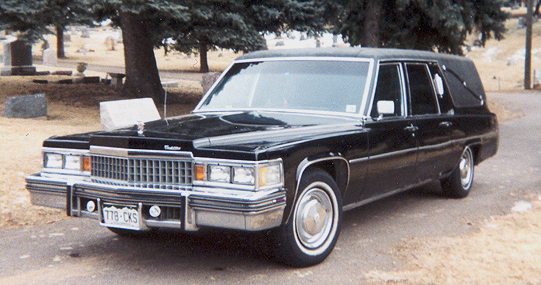
This car looks pretty nice, right? Based on this picture would you say it had a
fairly straight body? You'd never know it, but this car had serious
undercarriage rust, a rusted frame and LARGE portions of the door was actually
masking tape painted black, but it LOOKS good in pictures, doesn't it? We call
these 20/20 cars. They look good at 20 miles per hour or 20 feet away.
This is not to say people are intentionally trying to deceive you, it is just an
attempt to point out that you are almost always going to find the car is never
as mint as you thought it would be, so don't be surprised if there are extra
dings and such.
Reanimated corpses hiding under passenger side seat:

Be sure to lift all the seat cushions and check for the undead. A zombie is
generally a bad thing to have in your car, and are near impossible to get rid of
once you have them. Also because they are dead, they smell awful, worse than
hippies. If upon receiving your car you find it has a drooling unholy creature
from hell in it, check with your local parts store for Zombie spray. Also, some
insurance plans cover damage caused by drooling unholy creatures from hell,
check on your insurance cards for the abbreviation D.U.C.H. to see if your
policy covers acts of Zombie. A car under the control of zombies is an extra
investment because you are going to have to shoot them in the head to put them
down for good, and if you don't own a gun you are already putting in more money
to get one.
Incidentally, if you car was owned by hippies, you'll know. They ALWAYS have a
Grateful Dead sticker in the back window because hippies think that is the
worlds funniest joke, you know, because the name is Grateful DEAD, and it's on a
HEARSE, which is used for the DEAD! Yuk, yuk, yuk. Damn, I hate hippies.
Now then, being that there are many different types of hearses, this section is
designed to help you identify some of the trademark features and traits that
will let you know who made the hearse you are looking at. In nearly all cases,
looking at the design of the back end will tell you who made it if you can
identify the the details, for that reason, many of the following pictures are
close ups of these very features.
These are the main styles of hearses:
Landau
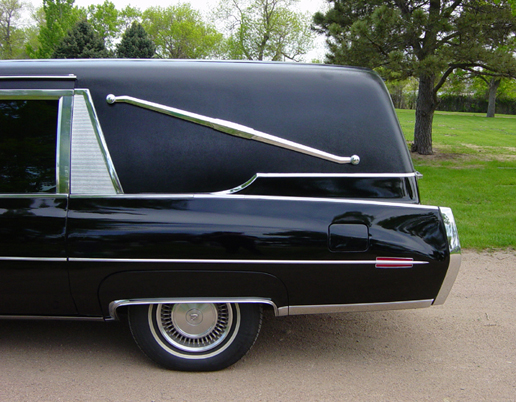
This refers to the chrome bar on the side of the casket compartment. This is the
most distinctive trademark of hearses to date.
FULL WINDOW, or LIMO STYLE
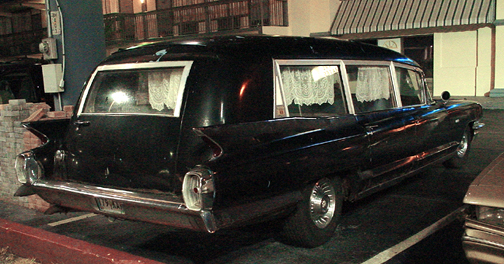
This stlye of hearse lacked the landau bar, and instead favored a full window design all the way around the car instead.
COMBINATION
(A combo of hearse AND ambulance!)
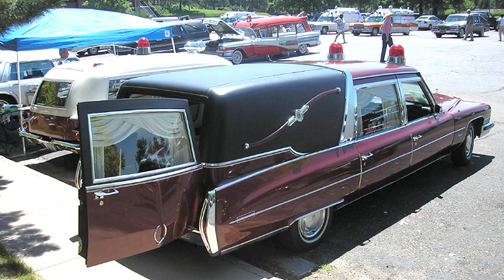
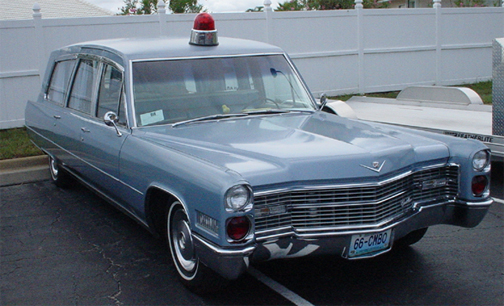
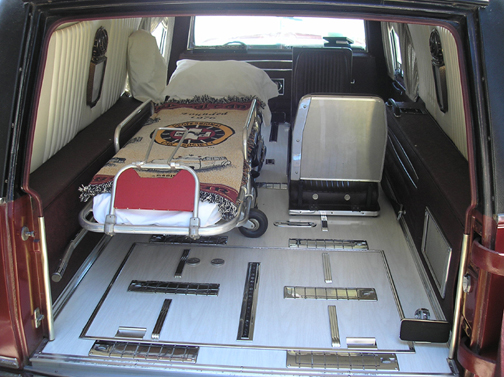
A hearse that was equipped with both funeral and ambulance equipment. In the old days, funeral homes ran ambulance services as well as funeral services. This called for some cars to double as both funeral cars and ambulances, featuring casket rollers, AND lights, sirens, gurneys, and oxygen equipment. Some even had removable landau panels, as illustrated by this car. Look closely and you can see the seams where the landau bar panels detach from the body on some combos.
3-WAY HEARSE
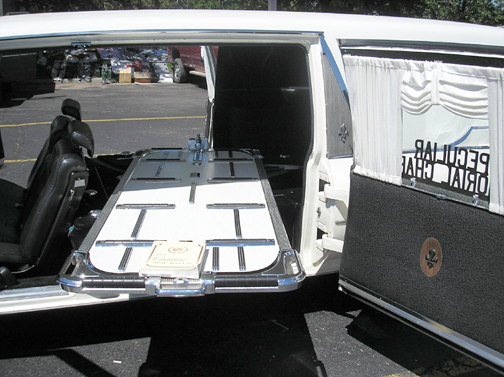

Considered by many to be the best style available, 3-way hearses featured no center divider (the thin wall with the glass window, much like a limousine) between the front and back interior, but instead had suicide doors, and a casket table that would extend out the back doors as well as the side of the car as well, so as to allow a funeral to be loaded from the curbside. Notice the suicide doors, which are necessary to unload the casket from the side. Important note, just because a hearse has suicide doors does not necessarily mean it is a 3 way, if there is a center partition it is an endloader.
Endloader
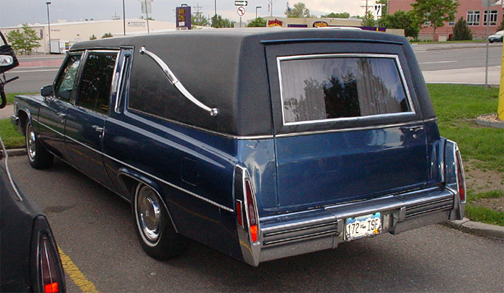
The most common type of hearse available, the endloader featured a center divider, and no casket table at all. Instead, the floor was outfitted only with casket rollers to ease the coffin into place. In some cases endloaders have suicide doors, but more often than not, the sport regular doors. Also common on and endloader is a center partition, a wall just behind the drivers compartment that seperates the front and rear. While some endloaders, like Oldsmobile and Pontiac, may or may not sport a center partition, you will NEVER see a 3-way hearse with a center partition. Some hearses that are endloaders will sometimes have a casket table that extends only out the rear door and not the side doors. This was present on many S&S hearses and a few Miller Meteors.
Who makes hearses?
Most of the time, as a new hearse owner, you are jumping into this thing cold, with no idea what makes one different from the other, that is the way I started out, this part gives you a loose idea of coach builers:
Hearses are made from Cadillac, Buick, Olds, etc but they are not made by these companies. What happens is this: The car company ( ie: Cadillac, Oldsmobile ) makes the frame, called a commercial chassis, a slightly longer frame than a normal car. This commercial chassis includes the engine, the front fenders, hood, grill, bumper, and a few other parts like tail lights, dashboard, seat, and steering wheel. This frame is then shipped to a company that does nothing but make hearses. They fabricate the doors, roof, interior, even most of the glass, on a purely custom basis. This make finding parts a bonifide pain in the ass.
Anyway, there are several large hearse makers out there, and this is a quick guide on how to distinguish the large ones:
Superior
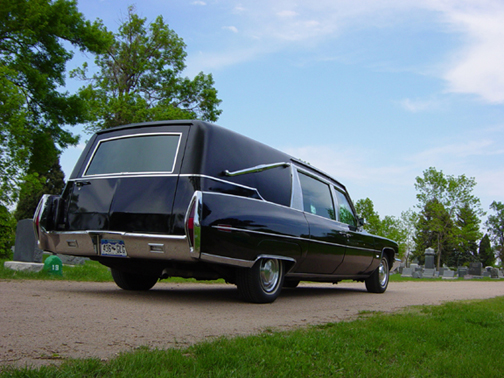
One of the most common hearses in production, Superior was responsible for mass production numbers of funeral vehicles and ambulances. Superior built on Cadillac chassis with a wide variety of styling. The most common way of telling one of these hearses is the chrome above the rear quarter panel. Unlike the M&M, Superior raised this chrome strip several inches as the line approached the rear of the hearse.
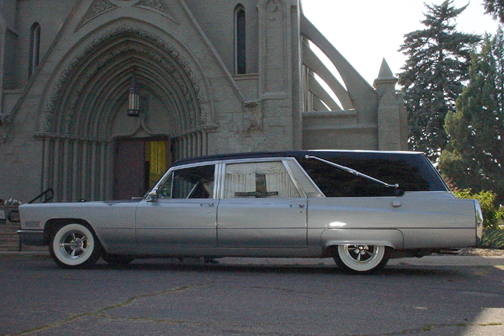
Another striking style present in Superior was the 'C-pillar' of the rear casket door. This last pillar in the door slanted dramatically forward, giving the car a sleek and dynamitc 'In motion' look, though mid-70's, the slanted doors all but disappeared from Superior styling. Another thing to keep in mind is that S&S shared the raised chrome piece, and Eureka shared the slanted casket doors, while both Eureka and S&S shared these styles to a much lesser extent (as can be seen an compared below) they were present, and can throw you for a loop when trying to identify the hearse if you are not aware of the subtle differences. Superior was the parent company of Consort.
Consort
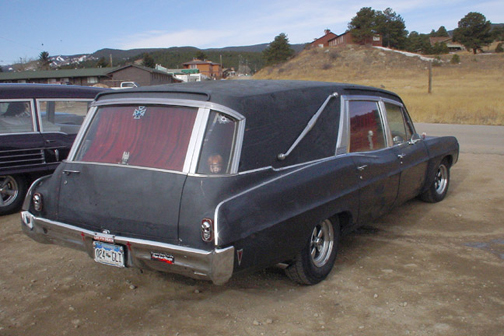
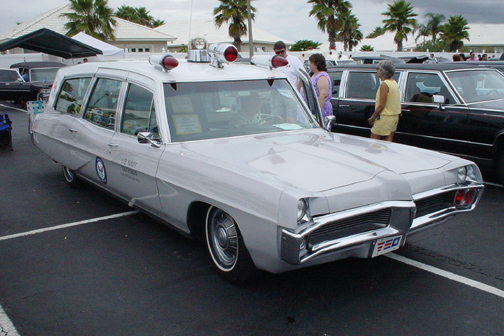
This offshoot of Superior was responsible for making Pontiac Bonneville based pro-cars. Sharing the same style as larger Superior hearses and ambulances, Consorts also usually had more head room than Cotner Bevington, their main competetor in the economy pro-car industry.
Sayers and Scovill
(Also known as S&S)
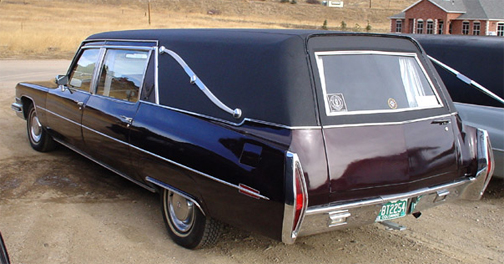
This company, known formally as Sayers and Scovill, was purchased by Hess and Eisenhart in 1942, was responsible for a slightly more ritzy funeral car. Their ads were geared towards funeral directors who were attracted to the idea of a costly, yet elegant funeral car. One ad for S&S was headlined by the phrase "Of course it costs more" reflecting this slightly esoteric companies regard for their craftsmanship. In case you really wanted to know, NO, S&S was not really better than any other hearse, as they built from the exact same Caddy chassis, and shared similarities with all other coach builders. The raised chrome piece is also present (to a lesser extent as seen here) Note that it is similar to the chrome piece pictured for Superior, but that it is smaller and more subdued.
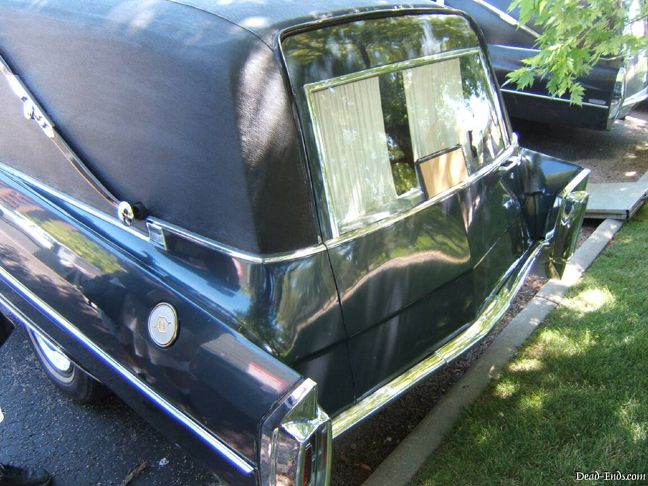
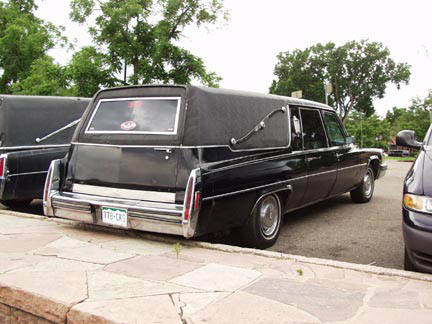
Side mounted lamps are also a common S&S trait, as seen here. Most prevalant on S&S, but just because the hearse sports a side lamp does not mean it HAS to be an S&S. Miller Meteor as well as Eureka also had this feature.
Miller Meteor
(Also known as M&M)
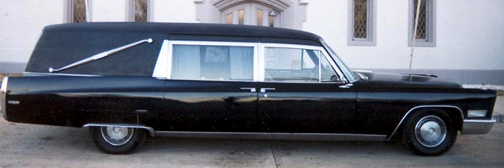
A large player in the field, Miller Meteors are easily distinguished by a straight chrome piece above the rear quarter panel and below the landau bar. This chrome is a straight piece all the way across the back door. Notice that the chrome does not raise at all in any manner, as opposed to Superior and S&S.
Another indicator is the metal
plate behind the casket compartment doors. All hearses had this plate, but M&M
plates were graced by this pointed cross. Another way to tell? Look for the M&M
logo, usually a metal insignia on the rear quarter panel
Cotner Bevington
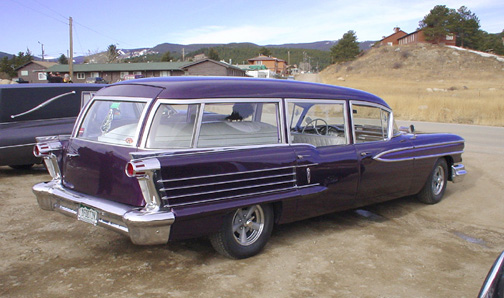
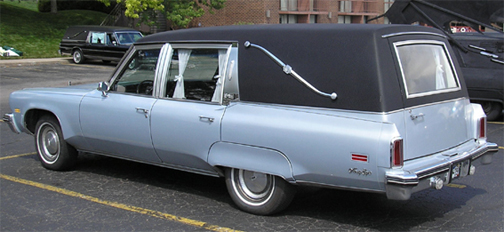
These hearses were made by an offshoot of Miller Meteor. CB hearses were known for being a lot cheaper (up to $5000 less than Cadillac hearses) and being faster as well. Of course these cars were also favored as ambulances due to their smaller size and greater speed. The way to identify a CB is to look at it and see if it is an Oldsmobile 98, as this was the ONLY car this company made professional vehicles out of. A common practice in ambulance services was to have a few Cadillacs (which were far more costly than CB's) and perhaps a Cotner Bevington ambulance as a secondary rescue vehicle. In ambulance form, these little cars, along with Pontiac Consorts, were considered to be the fastest cars to use as rescue vehicles.
Eureka

Where to start? Eureka was in operation until 1964 when it closed up shop. The best way to identify a Eureka is either the signature landau bars or the stream lined appearance of the body.
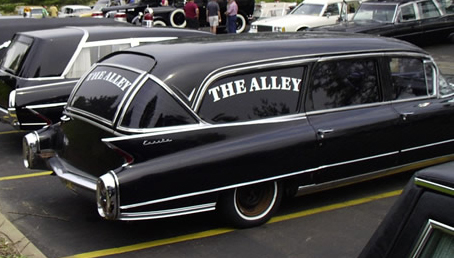
The best thing about Eureka was the solid construction of their doors. A great many hearses suffer through time, their doors start to sag and clatter (especially while in motion) Eureka doors were mounted slightly more sturdily and hence, do not drag and make as much noise as other hearses.
National
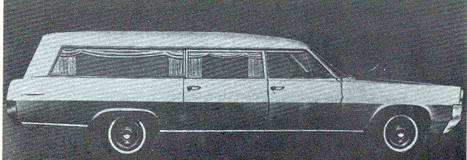
National- So relatively rare, I had a hard time even finding a photo of this builder! A coachmaker that was in operation in Indiana. National was one of the greatest, not because of their size or numbers of production (which was lower than the other hearse companies) but the fact that they would build a hearse out of ANY car you asked them to. They were responsible for one of the only 60's Mercury hearses out there. They built on a vast variety of cars, so the only way to identify a National, is to ask the owner, or look for a nameplate on the side of the car.
Flxible
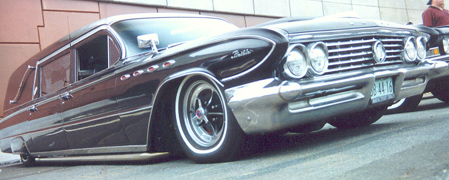
These cars are made by the strangley named outfit in Loudonville Ohio, this company went out of business in 1965f. How do you tell if it is a Flxible? It is a Buick, most likely. If you are looking for a rare hearse, with some distinctive features, this would be the one for you!
FINDING THE ACTUAL HEARSE
Where do you get hearses from? Well there are several good sources, so I'll start with the easiest. Calling funeral homes is a good start, many times a funeral home has a decent hearse that they are willing to part with in favor of buying a newer model.
Another place to look is current hearse owners. See, here is the thing: Many people buy a hearse thinking that it will be a good times car, a recreational vehicle. They do not plan to invest anything, they just plan to let it sit most of the year and take it out Super Bowl Sunday and on Halloween. They failed to take into account the fact that if you leave a car sitting, inevitably, things will break, seals in the engine will dry, batteries will go dead, etc. Their neighbors sometimes complain, their wife does not like having a 22 foot long embodiment of death in the driveway, or they have it stored on the street where it is accumulating parking tickets.
These hearses have, in many cases, become more than the owner bargained for, they have become burdens and eyesores. Of course there are the people who buy hearses and are enthusiasts who love and care for the cars, but when you pull up to a hulk that has 2 months of dirt on the hood, you know who you are dealing with right away.
Now, this is going to be...
The most important piece of information in this whole article!!!
Get some money together AHEAD OF TIME!!! I am dead serious here. Many people start looking for hearses, yet they have no money saved. They think that the seller wants to wait around a few months for them to scrounge up the pennies to buy their hearse. This does no good at all, I know that it would seem to go without saying, but you would be surprised by the vast amount of people who fail to make the connection between "I want to buy something" and "I don't have any money" that contributes to their failure when trying to buy a hearse. They seem to think that they are going to find a mint condition hearse for sale and that the seller is going to jump at the opportunity to sell it to them on the installment plan of $100 a month for the next 2 years. Not going to happen people.
People who are selling a car outright, say by advertising it in the paper or on the Internet, are not in the mood to wait around. By the time you get there, chances are they have already heard from several prospective buyers already, and are sick of the ‘We will let you know’ response.
I once sold a hearse for $3000, a mint 67 M&M 3-way. I had a lot of people come to look at it. I would have gladly taken as low as $1600 for the car provided that the person was someone who would take as good of care of the car as I had and that they had the money right there. I ended up selling the hearse to a haunted house that made me the highest offer, and had the money instantly.
When you go up to this current hearse owners house, it is immensely influential to have the cash right there, so even if it is less than they want to sell the car for, you can have the cash now. Look at it from their perspective: This person is at the door with say $1000. Sure they wanted $2500 for the hearse, but it has been sitting for a while, their wife has been nagging them about selling it, they never do anything with it anyway. They can either take the money, be $1000 richer than they were 2 minutes ago and be rid of the burden, or they can just go back to the couch and watch the rest of Wheel of Fortune. The choice is clear for most people. No, some people will not sell for that cheap, but it is just an example. Also, hearse clubs hate having members who constantly bitch about not owning a hearse, yet have no job, hence have no money. These people are in a constant state of bewilderment because they cannot figure out why they do not own a hearse yet. They just figure that they must live in the ONLY CITY on the entire planet where people do not walk up to random strangers on the street and say "HEEEEY, you look like you would look really snazzy driving around in a hearse, here, have the keys to this 1959 Superior 3-way, compliments of ME, and a total lack of REALITY" No, this will not EVER happen to ANYONE, EVER. If you have no money, AND yet you still have no hearse, this is what we on planet Earth call a connection.
So now, with that in mind, here are
some places to try:
Sendak Luxury
Hearses
Of course I'm going to pimp my own shit first and foremost. I spent a lot of
time writing this damned article, I gotta make it pay of for me somehow! I run
Sendak and we deal mostly in hearses that are fresh out of service and in
excellent shape, we do occasionally sell older coaches as well. Like us on
Facebook and select "See first" in your preferences to keep up on our stock.
You can also email us to keep up to date
here
Craigslist.org
Craigslist is an AMAZING site and unlike Ebay, it is not loaded with people who are trying to sell crap cars for too much. Check it daily! Also, go to www.jaxed.com and go to the vehicle section, this searches ALL of Ebay AND Craigslist and helps find some amazing deals!
C-W Coach Sales
7444 Vine Street
Cincinnati, OH 45216
Ph. 1-513-761-2275 or 1-513-821-6200
Internet http://www.cwcoach.com
Carl Woerner runs this Cincinatti based operation. A word of advice for getting a hearse: This man is your best bet all around, he is honest and his hearses are fair in price. If you are serious, get some money, go to Cincinnati and take a full day or two to look around his many lots. Talking to Carl on the phone may heed results, but he is a busy man, and does not have a lot of time to go over his entire inventory. Plus many of his cars are not listed on his Internet site.
Banes Professional Vehicles
Chicago Illinois, CHECK THEM OUT!
W.R. Bennett Funeral Coaches
319 East Main Street
Lowell, MI 49331
Ph. 1-616-897-5710
Fax 1-616-897-7080
E-mail rbennett@hearse.com
Internet http://www.hearse.com
Rance Bennet is the name if you are
in Michigan. In general, his cars run higher on price, but he has some nice
wheels.
http://www.ebay.com
I used to highly recommend Ebay, but these days it's nothing but sellers who
think they own a gold mine. Check it occasionally but I stick to Craigslist.
Ebay is a good source for parts still and an excellent source for things like
LED lighting kits which are an order of magnitude cheaper there than they are
elsewhere, especially places like Car Toys. Do it yourself and order your parts
from Ebay, it will save your wallet!